When people search for a Neocaridina shrimp book, they are usually not looking for a textbook on crustacean biology. They want something they can actually use beside the aquarium: a guide that answers the questions that start appearing as soon as you decide to keep Cherry Shrimp.
That distinction matters. Neocaridina are often described as easy shrimp, and in many ways they are. But “easy” can quickly become frustrating when a new keeper is trying to work out whether they need a heater, what GH and KH mean, whether their tank is cycled, why a shrimp failed to molt, or why there are no babies despite having males and females.
A genuinely useful book should anticipate those questions before you have to search for them one by one.
Why choose a specialist Neocaridina book?
In the aquarium hobby, the names Neocaridina shrimp and Cherry Shrimp are often used almost interchangeably for Neocaridina davidi. Red Cherry Shrimp may be the best-known form, but the same species is also kept in colours such as blue, yellow, orange, green, black and several different red grades.
That does not mean advice for every freshwater shrimp can be applied to Neocaridina. Caridina, Amano Shrimp, Ghost Shrimp and other freshwater shrimp can have different requirements. If you already know that Neocaridina are the shrimp you want to keep, there is a real advantage in using a guide that stays focused on them.
A specialist book does not need to keep interrupting itself with: “this applies to Cherry Shrimp, but not Crystal Reds,” or “this substrate is appropriate for one genus but not another.” It can spend that space going deeper into the decisions you are actually going to make.
If you are still deciding which shrimp you want to keep, a broader book may be useful. If you already have a tank full of Red Cherries or Blue Dreams, I would choose the specialist option. If you want to compare the different types of books available first, see my guide to the best Cherry Shrimp books for beginners.
1. It should start with the aquarium — not the shrimp
The first sign of a useful shrimp book is that it begins before you buy the shrimp.
Successful Neocaridina keeping starts with the environment. A beginner guide should explain aquarium size, substrate, decorations, filtration, heating, lighting and — critically — how the tank becomes biologically ready for livestock.
Filtration is a good example. There are successful shrimp keepers who run very lightly filtered tanks, and there are established systems that work without a conventional filter at all. But that is not the same as saying filtration has no value. In The Neocaridina Shrimp Handbook, my advice is that somebody newer to the hobby should use filtration because it is the easiest, most forgiving way to provide the beneficial bacteria that process ammonia and nitrite.
The same applies to heating. A good book should not simply tell everybody to buy a heater. It should help you decide whether you need one based on the temperature and stability of the room the aquarium is kept in.
Cycling needs a proper explanation
“Make sure your tank is cycled” is one of those phrases that appears everywhere online, but it is surprisingly unhelpful if nobody explains what cycling actually means.
A useful book should explain the nitrogen cycle in plain English: waste produces ammonia, beneficial bacteria process ammonia into nitrite, and another group of bacteria converts nitrite into nitrate. It should then explain the practical ways a new aquarium can develop enough bacteria to deal with the small amount of waste produced by shrimp.
In my handbook I discuss fish-in cycling, fishless cycling and my own preferred approach for shrimp tanks — using live plants from an established aquarium to help introduce beneficial bacteria. The important part is not that every reader must use my method. It is that they understand what “cycled” means well enough to make an informed decision.
“I would always recommend anyone newer to the hobby add filtration to their shrimp tanks.”— Richard James, The Neocaridina Shrimp Handbook
2. Water parameters should be explained, not just listed
This is probably the section where a good Neocaridina book earns its keep.
Search online for “Cherry Shrimp water parameters” and you will find endless charts. A beginner can very quickly end up believing that success depends on hitting one exact pH, one exact GH and one exact TDS reading.
A better guide should explain what the numbers mean and how they interact.
- Temperature: what range Neocaridina tolerate and why stability matters.
- pH: what it measures and why constantly chasing a target can be counterproductive.
- Ammonia: why it is highly toxic and should be kept at zero.
- Nitrite: why this second stage of the nitrogen cycle should also remain at zero.
- Nitrate: why the discussion is more nuanced than simply declaring one universal maximum.
- GH: how calcium and magnesium relate to hardness and successful molting.
- KH: how carbonate hardness helps buffer the water against sudden pH swings.
- TDS: what total dissolved solids actually measures — and what it does not tell you.
TDS is a particularly good test of whether a book is explaining the subject or merely repeating common shrimp-keeping advice. A TDS meter tells you the total amount of dissolved material in the water. It does not identify whether that material is calcium, magnesium, fertilizer, dechlorinator, nitrate or something else.
“In my experience, TDS is great for measuring freshly made RO water, but not great for measuring the water of your aquarium.”— Richard James, The Neocaridina Shrimp Handbook
Whether you agree with that conclusion or not, that is the sort of explanation I want from a specialist guide: not just “keep TDS at X”, but what the measurement represents and when it is actually useful.
3. Feeding advice should go beyond “buy shrimp food”
Neocaridina are detritivores. In a mature aquarium they spend much of the day grazing on algae, biofilm, decaying plant material and microscopic life on the surfaces around them.
A useful feeding section should therefore explain the difference between what shrimp naturally graze on and the supplementary foods we add. It should discuss variety, overfeeding, uneaten food and the role of established surfaces, plants and botanicals.
It should also make clear that baby shrimp are tiny and benefit enormously from having food available across the aquarium rather than relying entirely on one pellet dropped into one corner.
My own book covers several food types — including algae wafers, sinking granules, gel foods and frozen foods — but the more important lesson is understanding how Neocaridina feed rather than memorising a shopping list.
4. It should help you before and immediately after buying shrimp
A lot of care guides jump straight from “here is the ideal aquarium” to “now you have shrimp.” In the real world there are two important stages in between: choosing healthy animals and moving them into your water.
A good Neocaridina book should talk about sourcing. What should healthy shrimp look like? What warning signs should make you walk away from a seller? What should you ask about the water they have been kept in?
It should then discuss acclimatization without pretending there is only one acceptable opinion. In the handbook I explain both drip acclimation and the “plop and drop” method I have personally used when moving thousands of Neocaridina. My approach is based on my own results, but readers are given enough information to decide which method they are comfortable with.
That, to me, is one of the advantages of an experience-led book: you should be able to tell the difference between advice the author has personally used and advice that has simply been copied from somewhere else.
5. Sexing, breeding and the life cycle deserve proper space
For many people, breeding is the point at which keeping Neocaridina becomes addictive. You start with ten shrimp, spot your first berried female, then suddenly find tiny shrimplets appearing among the moss.
A useful book should show you how to tell males from females before it starts explaining breeding. With Neocaridina, clues include colour, overall size, abdomen shape, the larger plates sometimes referred to as the female's “skirt”, the visible saddle and, of course, eggs.
It should then explain what happens from mating through to a berried female carrying eggs beneath her abdomen, hatching and the development of the young.
Most importantly, breeding advice should connect back to the rest of the book. If a colony is not breeding, the answer may be sex ratio, age, temperature, food, stress, water quality or simply that the aquarium is not mature enough. Breeding is not an isolated chapter; it is the result of getting many of the earlier decisions right.
6. Molting should not be treated as a footnote
Neocaridina have an exoskeleton. As they grow, that rigid outer shell has to be shed and replaced. That makes molting central to shrimp keeping rather than a curiosity.
A specialist guide should explain normal molts, why calcium and other minerals matter, how GH relates to the molting process, and what hobbyists mean when they talk about the “white ring of death.”
This is exactly the kind of subject where beginners can panic after seeing something unfamiliar. A good book should help the reader distinguish a normal shed exoskeleton from a genuine problem — and understand when changing the water or adding products may create more stress rather than solving anything.
7. Tank mates need realistic advice
“Can I keep fish with Cherry Shrimp?” sounds like a yes-or-no question. It is not.
A useful book should explain the trade-off. Some small fish can coexist perfectly well with adult Neocaridina, while still eating newborn shrimplets whenever the opportunity arises. Whether that matters depends on whether your priority is a display aquarium containing fish and shrimp, or building the largest possible shrimp colony.
The handbook looks individually at snails and other invertebrates as well as several commonly considered nano fish, including Neon Tetras, Glowlight Tetras, Harlequin Rasboras, White Cloud Mountain Minnows, Green Neon Tetras, Otocinclus and Pygmy Corydoras.
The point is not to produce a magic “safe list”. It is to help the reader understand predation risk and make the choice that fits their goal.
8. Troubleshooting, pests and disease should be included
A beginner-focused book that stops once the tank is established leaves the reader alone at precisely the moment they are most likely to need help.
Neocaridina keepers eventually encounter things they did not expect: unusual white growths, worms on the glass, Hydra, Planaria, failed molts or an unexplained dead shrimp.
A good book should cover quarantine and help readers identify common pests and health problems before suggesting treatment. Identification matters because treating the wrong problem can be worse than leaving the aquarium alone.
In the handbook I cover Vorticella, Scutariella japonica, green fungus, muscular necrosis, Planaria, Hydra, detritus worms, pest snails and dragonfly or damselfly nymphs.
“Shrimp love stability!”— Richard James, The Neocaridina Shrimp Handbook
That is particularly important when something goes wrong. One dead shrimp is not automatically evidence that the whole aquarium needs to be stripped down, medicated and rebuilt. A useful guide should help you diagnose first and act second.
A simple checklist for choosing a Neocaridina shrimp book
If you are comparing books, I would look for one that can answer “yes” to most of these questions:
Does the book cover the whole Neocaridina journey?
- Does it explain tank setup rather than starting with shrimp already in the aquarium?
- Does it explain filtration and cycling in beginner-friendly language?
- Does it explain pH, ammonia, nitrite, nitrate, GH, KH and TDS rather than just list target figures?
- Does it cover feeding and the natural grazing behaviour of shrimp?
- Does it help you choose healthy shrimp and introduce them to your aquarium?
- Does it explain how to sex and breed Neocaridina?
- Does it cover molting and common molting problems?
- Does it give realistic advice about fish and other tank mates?
- Does it cover common pests, diseases and quarantine?
- Can you tell which advice comes from the author's own experience?
My view: page count matters far less than whether the book is useful when you are standing beside the aquarium trying to decide what to do next.
What does The Neocaridina Shrimp Handbook cover?
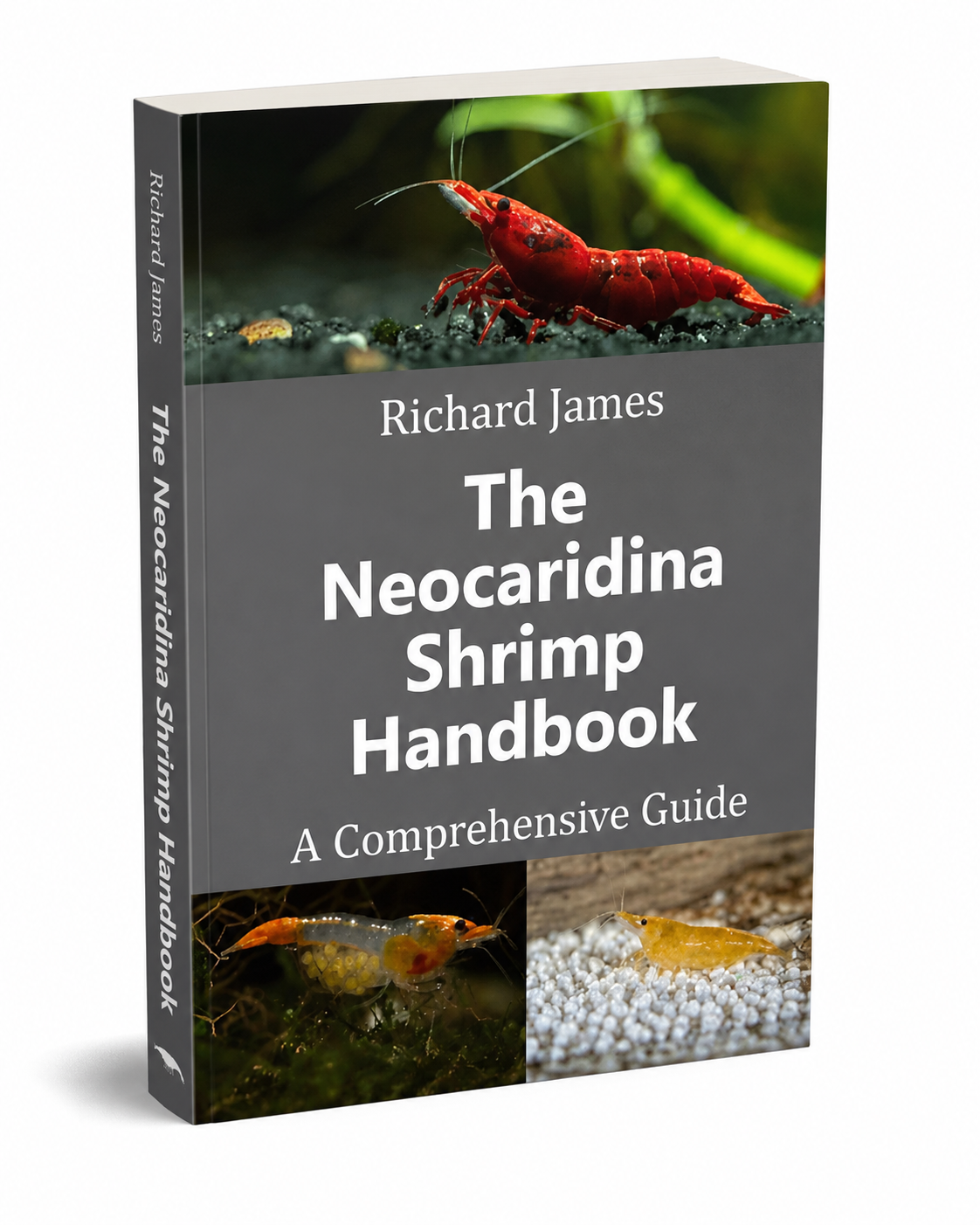
The Neocaridina Shrimp Handbook is 97 pages and was written specifically around Neocaridina davidi. It starts with the shrimp themselves — including anatomy, colours and grading — before moving through housing, substrate, decorations, heating, filtration, lighting and cycling.
From there it covers water parameters, copper and dissolved oxygen; live plants and botanicals; feeding; sourcing shrimp and acclimatization; sexing and breeding; the life cycle and molting; tank mates; quarantine; and common pests and diseases.
That structure is deliberate. I wanted the book to work in two ways: something a new keeper could read from beginning to end, and something an established keeper could pick up months later when they suddenly needed to check a particular subject.
If you want to compare it with other options first, you can also read my separate guide to the best Cherry Shrimp books for beginners.
Is a Neocaridina shrimp book worth buying?
You do not need to buy a book to keep Cherry Shrimp successfully. There is a huge amount of excellent free information online.
The problem is not a lack of information. It is that the information comes from hundreds of different people with different water, different tanks and different levels of experience. The same search can give you several confident but contradictory answers.
The value of a good book is having one coherent reference. You can understand the author's approach as a whole, see how the different subjects connect and return to the same source rather than starting from zero every time a new question appears.
If Neocaridina are only a passing curiosity, free articles and videos may be all you need. If you are setting up a dedicated shrimp tank, planning to breed them or simply want one reliable reference beside the aquarium, a specialist book makes much more sense.
The bottom line
If you are searching for a Neocaridina shrimp book, do not choose one simply because it has the longest contents page or the biggest page count.
Choose the guide that helps you understand the aquarium as a system: how the tank is cycled, what the water measurements actually mean, how shrimp feed and molt, what healthy breeding looks like, which animals can live alongside them and what to do when something goes wrong.
That is the standard I tried to meet when I wrote The Neocaridina Shrimp Handbook, and it is the standard I would use if I were choosing a shrimp book for myself today.

About Richard James
Richard has been keeping and breeding aquarium fish and shrimp since the early 1990s. He has worked in the aquarium trade, bred and sold thousands of Neocaridina shrimp, and now creates practical shrimp-keeping content and writes about the hobby.
Frequently asked questions
What should a good Neocaridina shrimp book cover?
At a minimum, look for aquarium setup, cycling, filtration, water parameters, feeding, sourcing and acclimating shrimp, sexing, breeding, molting, tank mates, quarantine and common pests or diseases.
Should a Neocaridina book explain GH, KH and TDS?
Yes. A useful book should tell you what those measurements mean, why they matter and their limitations. It should not simply give you three target numbers without explaining what is happening in the water.
Is a specialist Neocaridina book better than a general shrimp book?
If you already know you want to keep Neocaridina davidi, a specialist guide has more room to focus on the decisions and problems relevant to those shrimp. A broader book may suit you better if you are still deciding which freshwater shrimp to keep.
Are Cherry Shrimp and Neocaridina the same thing?
In everyday aquarium-hobby use, Cherry Shrimp generally refers to Neocaridina davidi. Red Cherry Shrimp are the classic colour form, but the same species is selectively bred in many other colours.